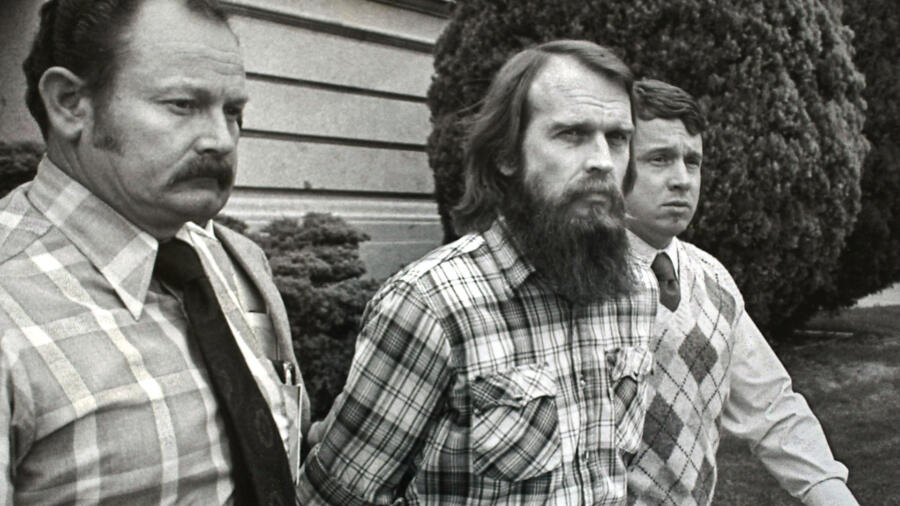
Slashed throats befell Allen Lafferty's 24-year-old wife, Brenda, and their infant daughter, Erica, when he got home from work on July 24, 1984. A vacuum cord was found around Brenda's neck in the kitchen of their American Fork, Utah, apartment; her 15-month-old daughter was discovered dead in her bloodstained cot.
"I went over to Brenda, and I prayed," Allen stated during his testimony in court.
Ron and Dan Lafferty, two of Allen's five brothers, escaped the state following the murders. However, they were apprehended in Reno, Nevada, a few weeks later. Brenda and Erica's murders were not denied. Ron said that his sister-in-law and niece had "become obstacles" in his life and that he had a divine insight to "remove" them.
In 1985, two separate trials found both brothers guilty of the double murder. The death penalty was not imposed on Dan. Even though Ron's original conviction was overturned on appeal, he was re-convicted and given a death sentence during his retrial in 1996.
Dealing With An Unhappy Sister-in-Law
The Lafferty brothers were trained by their father to distrust the government and modern medicine, and they were brought up as devoted members of the Church of Latter-Day Saints (or Latter-day Saints).
Their fanaticism increased in the year preceding the killings, as detailed in Jon Krakauer's investigative book Under the Banner of Heaven.
Their father's home was on the verge of being taken from them by the government when Dan stopped paying taxes. They would not budge from their refusal to treat their grandfather with traditional medicine when his diabetes became fatal.
Plus, they started praising polygamy more and more: Dan had a second wife, and Ron scared Diana, his wife, by saying he planned to marry off their adolescent kids to other women. Her decision to divorce Ron and go to Florida with their six children was a driving factor.
Following their 1983 excommunication from the Latter-day Saints church, Dan and Ron became deeply involved with a fundamentalist fringe group known as the School of Prophets. This group maintained that the main Latter-day Saints church had betrayed the religion's creed by permitting Black converts and outlawing plural marriage.
Not only did Dan try to recruit his five brothers into the cult, but he also pushed Ron to leave his job and fully commit to the organization. The idea that becoming a prophet was his greater calling grew increasingly apparent to Ron. Krakauer states that in the spring of 1984, he said that he had received about twenty "revelations" from God.
Two years into her marriage to Allen, Brenda infuriated Ron and Dan for various reasons. She went against their belief that wives should be obedient and submissive to their husbands by being college-educated, modern, and confident. After his wife and children departed, Ron became extremely resentful and blamed Brenda for facilitating the separation.
"Diana truly adored Brenda," Weeks announces. "Brendan gave Diana the strength to leave because the other [Lafferty] brothers' wives were treated like second-class citizens."
She forbade Allen, the youngest of six Lafferty brothers, from becoming a member of their new cult, which pleased neither brother.
Commands From On High To Murder
Krakauer claims that instructing adherents in the art of receiving and interpreting divine communications was a primary objective of the School of Prophets. Journal entries written by Ron were introduced by the prosecution during his trial.
These writings described his "revelation" to murder Brenda and Erica, as well as two other "removal" targets: individuals associated with Ron's divorce and excommunication. The brothers opted to get away after murdering Brenda and her kid; thus, they missed their other two targets.
Several fellow members of the School of Prophets were informed about Ron's "removal revelation" before the killings. Some rejected it, but they did nothing more. In addition to their mother and Dan, he informed Allen, who responded with suspicion.
"I informed him that God had not revealed anything like that to me, and I was prepared to give my life to protect them," Allen stated in court. Still, he failed to inform Brenda of Ron's vision.
Ron made an additional claim, stating that God had compared Dan to Nephi, a Book of Mormon person who "slayeth the wicked to bring forth [God's] righteous purposes."
"Dan acquiesced after Brenda and Erica were killed.]" Weeks mentions. He pondered the reason behind the lack of revelations.
Dan stated he murdered Brenda and Erica for "a matter of business" at Ron's retrial.
When asked about Dan's involvement on a more personal level, Weeks said that he felt terrible remorse about his role in Ron's divorce and subsequent unemployment.
In early 1984, with Brenda's assistance, Ron's wife abandoned him and fled to Florida with their six children. This occurrence, according to Weeks, was caused by Ron's collapse.
Diana—Ron's wife—had a deep affection for Brenda. According to Weeks, Brenda gave Diana the strength to leave because the other Lafferty brothers treated their spouses like second-class people. "Following that, he exhibited extreme religious fanaticism."
Mental Incompetence Or Religious Fanaticism?
While waiting for his trial, five months after the killings, Ron attempted suicide by tying a T-shirt to a towel rack. After coming to, he was able to stand trial decades later due to hallucinations and delusions brought on by oxygen deprivation, according to a psychiatrist's testimony in 2013.
After concluding that the judge had incorrectly determined Ron's mental capacity at his first trial in 1985, the 10th Circuit Court of Appeals mandated a second trial for him in 1991. In 1996, he faced a second conviction and was handed a death sentence. In subsequent appeals, Ron was denied a hearing by the Utah Supreme Court.
According to Weeks, "It was amazing to see how it had nothing to do with religion" throughout the 1996 retrial and court procedure. There is zero correlation between it and fanaticism. As far as crimes go, it was a classic case of passion.
Ron And Dan Lafferty: Where Are They Now?
At the Utah State Prison, Dan is serving two life terms at the same time. Parole is not an option for him. Ron passed away on November 11, 2019, after spending 34 years on death row and requesting a firing squad execution. He was a prisoner in Utah State Prison.
Throughout the appeals process, Ron's mental competency, both during the slayings and the trial, was a central issue. Weeks claims that seeing Ron's deteriorating condition solidified her opposition to capital punishment.
There was a real fear that someone might be executed, she recalls. "Are they serious about shooting a disabled person?"
According to Weeks, she has sympathy for the boys because they supposedly had a violent father growing up. The Deseret News stated that Dan's father, Ron, had a deadly altercation with his wife and reportedly used a baseball bat to beat their dog to death.
After what they did to her niece and sister, Weeks thinks Dan and Ron are sorry. Weeks stated her belief that Ron's remorse contributed to the suicide attempt, even though he never apologized.
Years later, Dan did apologize in a letter he sent to my parents. Weeks claims that Ron would never have publicly shown regret due to his narcissism.
Even after Ron's death, Weeks does not want the death penalty repealed. In 2016, she contacted V. Lowry Snow, her state representative, who would later propose HB 147. This measure aimed to make capital punishment illegal in Utah and added the possibility of a 45-to-life sentence for heinous murder.
A single vote in the State House Committee was all it took for the legislation to fail in February 2022.